Total Pageviews

Sunday, March 17, 2019

Impatiently awaiting...

Hiya!
I've been very busy lately and I haven't been able to write for a whole month or so. However, I'll keep being busy for a while, but due to a very good reason, no other than having a baby in... no time. In fact, the estimated delivery time for my baby was yesterday. My wife and I are eager to meet our child and that prompted me to write an entry dealing with some expressions related to impatience, you know, to kill the time while waiting for my child. I assume most of you are eagerly awaiting for something to happen at some time in  your lives, so, if that's your case, this entry is definitely for you! Shall we start?
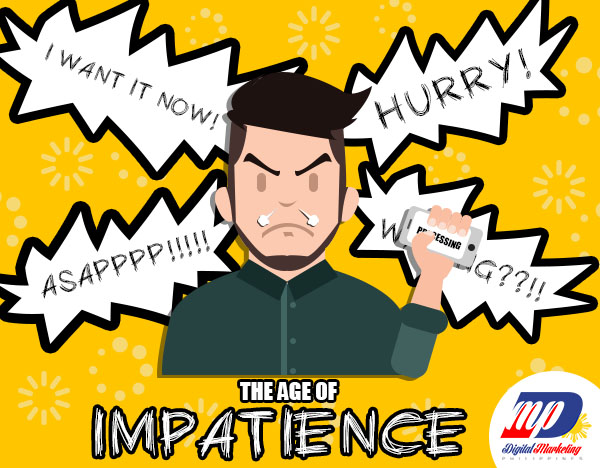
Image result for impatience
From: https://digitalmarketingphilippines.com/the-age-of-impatience-interesting-things-you-must-know/

1. I can't wait to...

This very useful expression is very common in spoken English. It is said when you are eagerly waiting for something, for example, 'I can't wait to meet my son.'
You can also use this expression using a new subject in the second part introduced with the preposition 'for', as in 'I can't wait for my son to be born.'

2. I'm eager to...
The adjective 'eager' is quite common to express that you are anxious (in a good sense) for something to happen, e.g. you can say that you are eager to enjoy your holidays. 

3. I'm looking forward to...
This phrasal-prepositional verb indicates that you want something to happen. It can be followed by a noun phrase, as in 'I'm looking forward to the concert' or by -ing if it is a verb, for instance, 'I'm looking forward to hearing from you soon.' In fact is one of the few structures in English combining the preposition 'to' and the -ing form. 

4. I long for...
You normally know the word 'long' as an adjective, being the opposite of 'short'. However, 'long' can also be used as a verb, followed by the preposition 'for'. In this case, it means to desperately want something, for example, 'I long for some time for myself.'

5. I yearn for.../ yearn to...
You use this expression in FORMAL English to let others know that you are eager for something to happen. 'I yearn for home-made food.' or 'I yearn to savour my mother's home-made food.'

6. I'm keen to...
The adjective 'keen' has become commonplace in today's conversations. You can say that you're keen to visit your relatives overseas, for example. 

7. I'm enthusiastic about...
If you are enthusiastic about doing something, that means you can't wait for that something to happen. In my case, as I have previously repeated, I'm enthusiastic about meeting my son!

8. I feel like + -ing...
This is a common expression in informal English. However, it is not as emphatic as the previous ones. You can say that you feel like eating ice-cream, but that is not a big deal for you. 

9. I wish...
The verb 'wish' is used in multiple different ways in English:
- You can wish for something, for example, I always wish for snow at Christmas.
- You can wish for something to happen. In my case, I wish for my wife to give birth.
- I wish + simple past: when you wish for something that could happen but you are not really optimistic about it, for example, I wish I were taller. 
- I wish + would: when you one someone to stop doing something or start doing something, when you want someone to change their habits, as in 'I wish you would behave well with your mother.'
- I wish + past perfect: when you regret something you did in the past but it has no solution now. My grandpa wishes he had studied more, for example. 

10. I crave for...
This verb is normally followed by food or drinks and it is a typical structure said among pregnant women. Pregnant women have cravings, that is, they crave for chocolate, for example. 

11. I would die for...
This hyperbolic expression indicates that you are so eager for something that you could even die for it...For instance, if you are starving, you would definitely die for a bite to eat. 

12. I'm on edge...
You are on edge when you are so worried and anxious about something. I'm normally on edge when I want to know my exam results.

Well, right now I could use all these expressions. My restlessness will hopefully come to an end when I hold my child in my arms...
If you are interested in knowing more words and expressions about this topic, why don't you revisit my entry on expressions related to nostalgia?
P.S. I'll probably be absent for a while... but I'll come back, I promise! 

Sunday, February 10, 2019

A fresh new start

Well, folks, I've been busy over the last month and I haven't been able to write anything! Too bad! Well, last year's last entry was about expressions related to the end, so now I think it is feasible to write one with expressions related to the beginning of something. I think it is a great idea, given that the year 2019 is at its  beginning and there are countless opportunities to start something new. Let's see some expressions related to new beginnings:

1. Beginner's luck
Image result for beginner's luck
From: https://www.youtube.com/watch?v=qE15YGNodb4 


This idiom refers to the fact that newbies frequently have a streak of luck when they try something (game, challenge....) for the first time, and for the first time only.

2. A fresh new start

Image result for a fresh new start
From: https://8tracks.com/musicthatisntbad/fresh-new-start


This expression is used when you have a new opportunity at something. 

3. A new beginning

Image result for a new beginning
From: https://www.123rf.com/photo_69321701_today-is-a-new-beginning-hand-lettering-motivational-message.html


Like in the previous example, a new beginning is yet another opportunity to do something. 

4. To start anew / to start afresh

Image result for start anew
From: https://quotefancy.com/quote/1348970/Georgia-O-Keeffe-I-decided-to-start-anew-to-strip-away-what-I-had-been-taught


This is a useful expression when you want to stop doing something and start it again in a different way.

5. Wipe the slate clean
Image result for wipe the slate clean
From: https://www.pinterest.com/pin/481533385137783104/


This idiom is used to eliminate all your previous thoughts or ideas and start anew.

6. Start over

Image result for start over meaning
From: https://thebloomingjasmine.com/tag/starting-over/


When you add the adverb 'over' to the verb start, it means that you want to make a new beginning

7. From scratch
Image result for from scratch meaning
From: https://www.pinterest.com/pin/305611524704649861/
To do something out of nothing, from the very beginning.

8. Freshers / freshman year
Image result for freshers
From: https://www.yusu.org/events/70012/vanbrugh-freshers-2018

In the UK system, a fresher is the person studying at university during the first university year. 

9. Once upon a time...
Image result for once upon a time fairy tales
From: https://www.signature-gifts.com/product/once-upon-a-time-collection-of-fairy-tales/


This entry wouldn't be complete without the widely-known phrase used to begin most fairy tales... How nostalgic!

10. Verbs and expressions related to beginnings

There are a lot of verbs related to new beginnings:

- Begin
- Start
- Commence
- Initiate
- Originate: This verb is intransitive, that means it has no direct object, for example, 'a storm originated' (not 'they originated a storm')

Other verbs are partially related to this new beginning:
- Inaugurate (start a new business, shop...)
- Introduce a new idea in the market. 
- Launch a new product

11. Linkers and conjuncts related to beginnings

To structure your speech, you can use a great deal of expressions related to beginning:
- First,
- Firstly,
- First of all,
- In the first place
- At first,
- At the (very) beginning,
- To start with,
- To begin with,
- For starters,
- As a starting point,
- First and foremost  (to indicate that the first thing you are going to mention is the most important one, i.e. there are a lot of reasons to study English. First and foremost, English is useful in international communication...)

Well, now that you have learnt some more expressions related to new beginnings, it is your turn to start anew: take up a new hobby, try something new, embark on new projects and be optimistic!
See you around.

Friday, January 4, 2019

The origin of New Year's resolutions

Welcome to my first entry of this blog in 2019! By the way! Happy New Year! Well, did you get to eat your 12 grapes! Hope so! Have you made any New Year's resolutions? Well, last year I wrote an entry on New Year's resolutions. This year,  I propose I little reading exercise on New Year's resolutions. Beware! This text is aimed at students with B2 level or so ! Here you have the text and you can download the answers at the end. The text in highly interesting, as you can learn lots of new stuff related to the origins of New Year's resolution and why people decided to start this tradition. I hope you like it!


DOWNLOAD DOCUMENT

DOWNLOAD ANSWERS TO THE EXERCISE

Thursday, December 27, 2018

This year is coming to an...end

I'm finding it more and more difficult to continue writing this blog and it seems that I can't find time lately to keep writing, but I'm gonna do my best and write from time to time. It's been almost two months since I last wrote another entry and suddenly , as the post title suggests, the year 2018 is coming to an end. we are in the middle of Christmas already! If you feel like learning something related to Christmas, click on my former entries related to Christmas: New Year resolutionsChristmas-touching videosBoxing Day; Christmas vocabulary; Christmas videos; Practise your listening at Christmas; Christmas carols; Christmas in Spain, the UK and the USChristmas short storiesChristmas originsChristmas gift-bringers all across the world.

Today, though, my entry is not gonna be Christmasy at all. Instead, now that the year is close to finish I'll be sharing with you some expressions related to the end in English:

1. To be over: When something is over, it means is completely finished. Who hasn't seen the expression "Game over" as a child, probably the most hated expression when you were having fun, he he he. If you are one of the unlucky ones, you may have heard the words "it's over" from your couple, hopefully not! From this, there are two interesting idioms that people use to cast some hope: "it ain't over till it's over", meaning that we must not give for granted the ending of something until it is completely finished. Likewise, the similar expression: "it ain't over till the fat lady sings" is used with the same meaning. The idiom makes reference to the opera and to the cliché that sopranos are a bit overweight. 
Image result for it's not over until the fat lady sings
From: https://blingee.com/blingee/view/97320609-IT-S-NOT-OVER-TILL-THE-FAT-LADY-SINGS-TOP-6
Similarly, one can use the expression "it's not over" as a threat to indicate that something is far from being finished. 

2. To come to an end: As the title of this post preaches, the expression "come to an end" indicates that something is on the verge of finishing. From this, there's an idiom: "all good things must come to an end" meaning that most things (even good things) are temporary and won't last forever. 

Image result for all good things come to an end meaning
From: https://twitter.com/KnownProverbs/status/1021646793149374464/photo/1


3. The end of the line / the end of the road: The very end of something; the final step of a process or person; the point beyond which survival or continuation seems impossible. If you say this is the end of the road for a company, it means, it will probably go bankrupt and close down very soon. 

Image result for the end of the road meaning
From: http://sgst.com.au/2015/06/end-of-the-road-2/
4. The end is nigh: This is an old-fashioned idiom coming from the Bible meaning that the end is very near. It was a prediction of the upcoming apocalypse. 

5. Fight / defend something to the bitter end: When you know that something is going to end poorly, but, in spite of that, you fight hard to prevent it form happening, no matter what. 

6. Bring something to a close / wrap something up: If you bring something to a close, or wrap something up, it means you  finish it, i.e. you can bring a meeting to a close or wrap it up. In informal English, you can wind something up

7. Verbs related to the end: 'Finish' and 'end' are two verbs used in everyday English. However, there's a formal counterpart: 'terminate.' In London buses, you can hear the verb 'terminate' to indicate the final stop of the line. 

8. End up: This verb is used when something finishes unexpectedly.  It is normally followed by a verb in -ing. Even though I studied hard and the exam went well, I ended up failing! The same meaning can be expressed by means of 'wind up'

9. Finish off: In informal English, this verb is used to indicate that something is completely finished: you can finish off an assignment for school, or, in more serious terms, you can finish someone off (if you are a hitman). 

10. Tie up loose ends / add the finishing touches to something: These two expressions are used to indicate that something is incomplete and with some final effort, you perfect it. The first one has been traditionally used in crime. You tie up loose ends when you make sure that no one can get to know that you committed a crime. The second expression, however, is way more optimistic. Conscientious people usually add the finishing touches to something to make it perfect. 

Well, the end of my post is nigh, my friends. To finish it off , here you have two widely-known songs related to the end. I hope you like them. See you around.


Sunday, November 4, 2018

Let's learn some idioms related to death (II)

Hiya! 
How did you spend your Halloween night? Did you dress up and eat lots of candy? Did you watch some horror movies or was it just a normal night?
As you know, last Thursday was All Saints' Day, the day when we remember our loved ones that departed long time ago. In fact, last week, to somehow celebrate Halloween I wrote an entry on some words related to death. Today I intend to continue that entry by writing about some idioms and euphemisms meaning "die" or "pass away". There are lots of expressions involving dying in English and some of them are really quirky!

1. Kick the bucket

Image result for kick the bucket
From: https://grammarstammer.weebly.com/words-to-the-wise/kick-the-bucket-bucket-list
Interesting expression, don't you think? In Spanish we call this: "straighten your leg." Its origin is not very clear but it is believed that in the past, people hanging in a noose would kill the bucket to release the rope and commit suicide. 

2. Six feet und
er
Image result for six feet under expression
From: https://co.pinterest.com/pin/349521621065419434/


This expression deals with the place where people are buried after they die. It all dates back to seventeenth century London where the Great Plague was killing the population. The mayor of London then ordered to bury the corpses, at least, six feet under to avoid the spread of the disease. This expression has then survived until the present moment and it was even the name of a well-known TV series. 

3. Push up daisies


Image result for push up daisies
From: https://www.123rf.com/photo_8032315_an-image-representing-pushing-up-daisies-.html


Well, the origin of the expression is blurred but it obviously refers to the fact that daisies eventually grow up on the land where the dead are buried. 

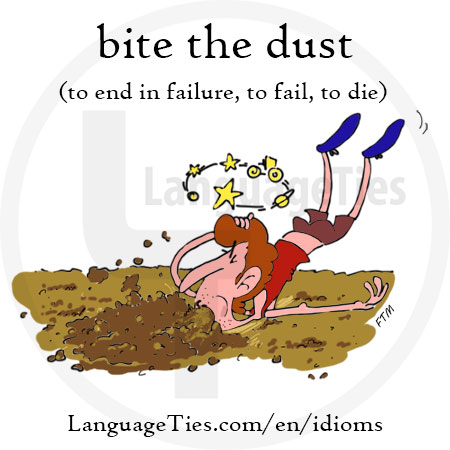
4. Bite the dust
Image result for bite the dust

This expression seems to have originated in the Bible and it is associated to destruction and death. Nowadays, other than dying, it also means 'being defeated in a competition'. 

5. Give up the ghost
Image result for give up the ghost die
From: http://lelandnqgrekin.blogspot.com/2010/06/give-up-ghost.html


Once again, its origin traces back to the Bible. Give up the ghost can be interpreted as 'becoming a ghost oneself', that is, dying. But it can also be used with machines and devices when they stop working.

6. (Be/become) food for worms
I will just save the picture with this expression so as not to be gross, but I suppose you get the real picture. If you become food for worms that means you are dead and worms will feed from you...

7. Take a dirt nap
Image result for take a dirt nap
From: https://www.pinterest.es/pin/154389093451057064/


Well, the meaning is quite clear, isn't it? If you take a dirt nap it means, you're dead and buried. Not very pleasant, I must say.


8. Cash in (one's chips)
Image result for cash in one's chips
From: https://confusingtimes.tistory.com/304


You cash in your chips in a casino as a final step, when you want to go home with your cash. By the same token, you cash in your chips when you die as a final step in your life.

9. Draw your last breath 


Related image
From: https://www.abc.net.au/news/health/2017-05-26/what-to-expect-when-someone-is-dying/8550490


Sad though it sounds, when you draw your last breath that means you stop living, normally after a long illness. 

10. Turn belly up


Image result for turn belly up
From: https://www.amazon.com/Belly-Up-FunJungle-Stuart-Gibbs/dp/1416987320


If you turn belly up, that means you can no longer turn belly down. Its origins may have to do with fish, which turn belly up when they die.

11. Meet one's Maker


Image result for meet one's maker
From: https://blog.oxforddictionaries.com/2015/11/02/synonyms-for-dying/


Well, this expression has a religious value. You meet your Maker in the afterlife, after you have passed away.

12. To be dead as a dodo / doorknob / rock / doormat / graveyard / doornail


Image result for to be dead as a dodo
From: https://www.singularityweblog.com/why-humanity-is-dead-as-the-dodo/


The use of similes is a good way to emphasize that someone is dead. My favourite one is 'dead as a dodo'. As you know, a dodo is an extinct animal that died long time ago.

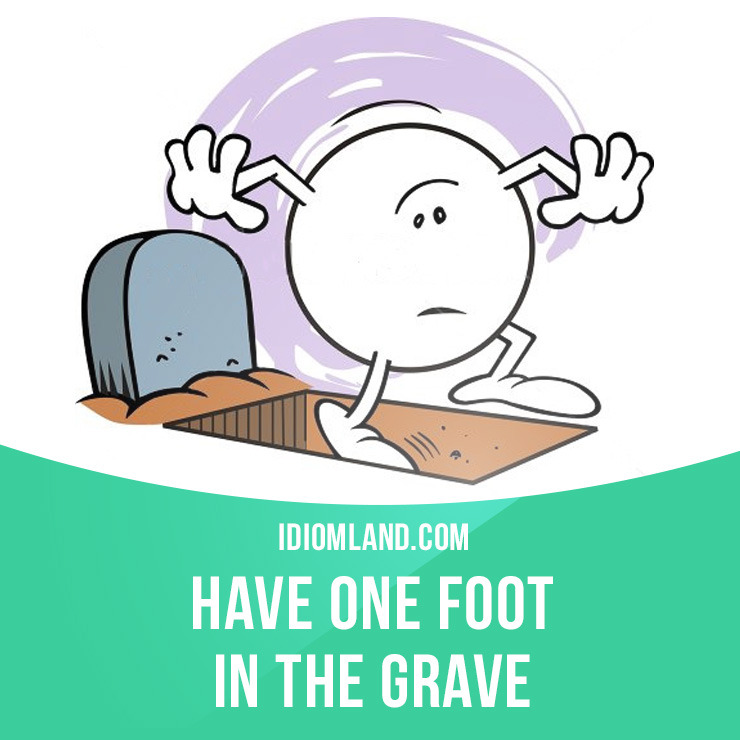
13. To have one foot in the grave
Image result for one foot in the grave die

This expression refers to someone who is about to die. 

14. Pop your clogs


Image result for pop your clogs
From: https://www.vappingo.com/word-blog/pop-your-clogs/


The origin of this phrase is unclear, but it's another way of referring to death. 

15. Buy the farm


Image result for buy the farm
From: https://www.pinterest.es/pin/26317979052476333/


One of the possible origins of this idiom may be related to war. When pilots were injured in war and died their planes sometimes crashed into a farm and the farmer sued the state for compensation. Sometimes, the state had to buy the whole farm. 

It is quite clear that death is present at all times and this is reflected in the language as there are a great deal of expressions associated to it. Which one is your favourite?