Welcome to my first entry of this blog in 2019! By the way! Happy New Year! Well, did you get to eat your 12 grapes! Hope so! Have you made any New Year's resolutions? Well, last year I wrote an entry on New Year's resolutions. This year, I propose I little reading exercise on New Year's resolutions. Beware! This text is aimed at students with B2 level or so ! Here you have the text and you can download the answers at the end. The text in highly interesting, as you can learn lots of new stuff related to the origins of New Year's resolution and why people decided to start this tradition. I hope you like it!
Today, though, my entry is not gonna be Christmasy at all. Instead, now that the year is close to finish I'll be sharing with you some expressions related to the end in English:
1. To be over: When something is over, it means is completely finished. Who hasn't seen the expression "Game over" as a child, probably the most hated expression when you were having fun, he he he. If you are one of the unlucky ones, you may have heard the words "it's over" from your couple, hopefully not! From this, there are two interesting idioms that people use to cast some hope: "it ain't over till it's over", meaning that we must not give for granted the ending of something until it is completely finished. Likewise, the similar expression: "it ain't over till the fat lady sings" is used with the same meaning. The idiom makes reference to the opera and to the cliché that sopranos are a bit overweight.
Similarly, one can use the expression "it's not over" as a threat to indicate that something is far from being finished.
2. To come to an end: As the title of this post preaches, the expression "come to an end" indicates that something is on the verge of finishing. From this, there's an idiom: "all good things must come to an end" meaning that most things (even good things) are temporary and won't last forever.
3. The end of the line / the end of the road: The very end of something; the final step of a process or person; the point beyond which survival or continuation seems impossible. If you say this is the end of the road for a company, it means, it will probably go bankrupt and close down very soon.
4. The end is nigh: This is an old-fashioned idiom coming from the Bible meaning that the end is very near. It was a prediction of the upcoming apocalypse. 5. Fight / defend something to the bitter end: When you know that something is going to end poorly, but, in spite of that, you fight hard to prevent it form happening, no matter what. 6. Bring something to a close / wrap something up: If you bring something to a close, or wrap something up, it means you finish it, i.e. you can bring a meeting to a close or wrap it up. In informal English, you can wind something up.
7. Verbs related to the end: 'Finish' and 'end' are two verbs used in everyday English. However, there's a formal counterpart: 'terminate.' In London buses, you can hear the verb 'terminate' to indicate the final stop of the line.
8. End up: This verb is used when something finishes unexpectedly. It is normally followed by a verb in -ing. Even though I studied hard and the exam went well, I ended up failing! The same meaning can be expressed by means of 'wind up'.
9. Finish off: In informal English, this verb is used to indicate that something is completely finished: you can finish off an assignment for school, or, in more serious terms, you can finish someone off (if you are a hitman).
10. Tie up loose ends / add the finishing touches to something: These two expressions are used to indicate that something is incomplete and with some final effort, you perfect it. The first one has been traditionally used in crime. You tie up loose ends when you make sure that no one can get to know that you committed a crime. The second expression, however, is way more optimistic. Conscientious people usually add the finishing touches to something to make it perfect.
Well, the end of my post is nigh, my friends. To finish it off , here you have two widely-known songs related to the end. I hope you like them. See you around.
Hiya! How did you spend your Halloween night? Did you dress up and eat lots of candy? Did you watch some horror movies or was it just a normal night? As you know, last Thursday was All Saints' Day, the day when we remember our loved ones that departed long time ago. In fact, last week, to somehow celebrate Halloween I wrote an entry on some words related to death. Today I intend to continue that entry by writing about some idioms and euphemisms meaning "die" or "pass away". There are lots of expressions involving dying in English and some of them are really quirky! 1. Kick the bucket
Interesting expression, don't you think? In Spanish we call this: "straighten your leg." Its origin is not very clear but it is believed that in the past, people hanging in a noose would kill the bucket to release the rope and commit suicide. 2. Six feet under
This expression deals with the place where people are buried after they die. It all dates back to seventeenth century London where the Great Plague was killing the population. The mayor of London then ordered to bury the corpses, at least, six feet under to avoid the spread of the disease. This expression has then survived until the present moment and it was even the name of a well-known TV series. 3. Push up daisies
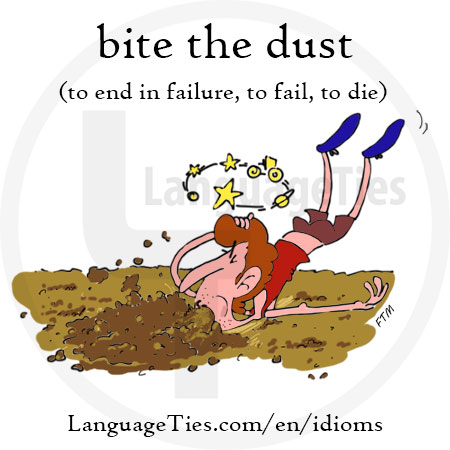
Well, the origin of the expression is blurred but it obviously refers to the fact that daisies eventually grow up on the land where the dead are buried. 4. Bite the dust This expression seems to have originated in the Bible and it is associated to destruction and death. Nowadays, other than dying, it also means 'being defeated in a competition'. 5. Give up the ghost
Once again, its origin traces back to the Bible. Give up the ghost can be interpreted as 'becoming a ghost oneself', that is, dying. But it can also be used with machines and devices when they stop working. 6. (Be/become) food for worms I will just save the picture with this expression so as not to be gross, but I suppose you get the real picture. If you become food for worms that means you are dead and worms will feed from you... 7. Take a dirt nap
Well, the meaning is quite clear, isn't it? If you take a dirt nap it means, you're dead and buried. Not very pleasant, I must say.
8. Cash in (one's chips)
From: https://confusingtimes.tistory.com/304
You cash in your chips in a casino as a final step, when you want to go home with your cash. By the same token, you cash in your chips when you die as a final step in your life. 9. Draw your last breath
If you turn belly up, that means you can no longer turn belly down. Its origins may have to do with fish, which turn belly up when they die. 11. Meet one's Maker
Well, this expression has a religious value. You meet your Maker in the afterlife, after you have passed away. 12. To be dead as a dodo / doorknob / rock / doormat / graveyard / doornail
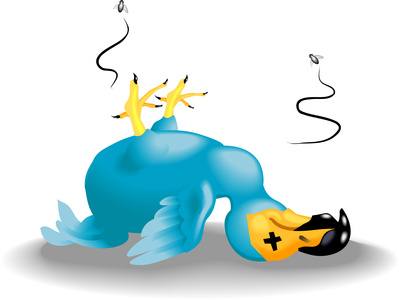
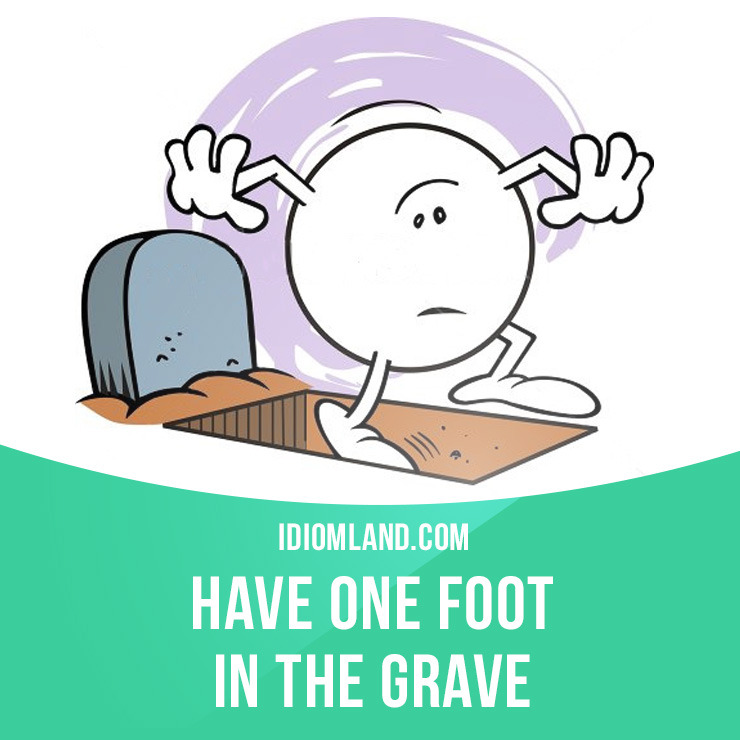
The use of similes is a good way to emphasize that someone is dead. My favourite one is 'dead as a dodo'. As you know, a dodo is an extinct animal that died long time ago. 13. To have one foot in the grave This expression refers to someone who is about to die. 14. Pop your clogs
One of the possible origins of this idiom may be related to war. When pilots were injured in war and died their planes sometimes crashed into a farm and the farmer sued the state for compensation. Sometimes, the state had to buy the whole farm.
It is quite clear that death is present at all times and this is reflected in the language as there are a great deal of expressions associated to it. Which one is your favourite?