Total Pageviews

Saturday, October 13, 2018

Born out of wedlock...and other interesting expressions related to weddings!

Hiya!
Last year at this point I would have already walked down the aisle! That means it's been a year since I got married! In particular, I got married last 7th October 2017! It's also been a year since I wrote three very interesting posts related to weddings: one on wedding vocabulary; one on wedding traditions; and one on best men and maids of honour. Well, today I would like to show you some expressions related to weddings or said at wedding celebrations!

1. Born out of wedlock: This expression is said to someone whose parents are not legally married, that is, a child born out of the institution of marriage ('wedlock' being an old-fashioned synonym for 'marriage.' This is pretty much what happens nowadays! There are countless of couples who become parents before walking down the aisle, and there's nothing wrong about it! The image perfectly summarizes the idea:
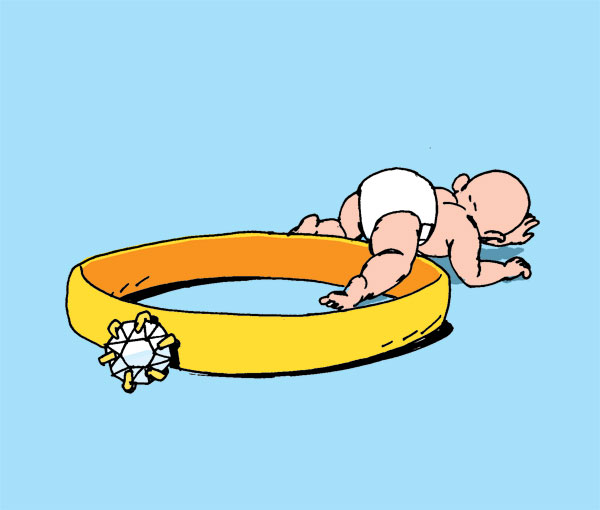
Image result for out of wedlock
From: https://azea3307gks.wordpress.com/2018/05/22/child-out-of-wedlock-they-are-not-criminals/

2. An illegitimate child: Technically an illegitimate child is a child born out of wedlock, that is, when parents are not legally married, but there are other possible scenarios. An illegitimate child can be the child of a parent legally married to someone, only this parent had the son with a lover or mistress. In this case, the illegitimate child is often called a 'bastard'.


3. A shotgun wedding: Very interesting and hilarious expression. Can you guess the meaning from its context? A shotgun wedding is a wedding celebrated very quickly to avoid embarrassment, maybe  because the bride is with child. 

Image result for a shotgun wedding
From: https://www.thinkadvisor.com/2015/06/16/5-ways-ppaca-cushion-programs-could-drive-dealmaki/?slreturn=20180913151053

4. Walk down the aisle / Lead someone to the altar
: Both expressions are synonyms of 'getting married'. The first one refers to the path leading to the altar that both the bride and the groom must walk to become spouses. The second expression refers to the sacred place where the wedding takes place (just at the end of the aisle). However, when you have second thoughts about a wedding (have cold feet), you can end up dumping someone at the altar and running away from them!

Image result for walk down the aisle
From: http://www.bridebox.com/blog/walking-down-the-aisle/
5. Cheers to the bride and groom: After the religious celebration, guests may want to wish the spouses the best through a toast. They deliver a speech and they finish it with the sentence: "cheers to the bride and groom" (or "here's to the bride and groom") and then everyone must toast! 

Image result for cheers to the bride and groom
From: http://www.roofgardengalveston.com/heres-to-the-bride-and-groom-wedding-toast-tips/?doing_wp_cron=1539458338.3728730678558349609375
6. Here comes the bride: This expression is in fact part of the bridal chorus; it's the first composition heard at a wedding ceremony just when the bride walks down the aisle to the altar! 

Image result for here comes the bride
From: https://es.dhgate.com/product/wholesale-rustic-wedding-here-comes-the-bride/262794261.html

7. I now pronounce you husband and wife
: This is the final sentence that the priest utters in a wedding celebration to make join the bride and the groom and make them spouses and to give closure to the wedding ritual. This sentence can be followed by the words: 'you may now kiss the bride'. 
Image result for and i pronounce you husband and wife
From: https://me.me/i/i-now-pronounce-you-husband-and-wife-you-may-update-3644394

8. Till death do us part: This sentence is said by the spouses to swear each other fidelity for all the eternity. It means "until death separates us". 


9. "Marriage isn't a word, is a sentence": This quote is a play on words with two meaning of the word 'sentence'. On a linguistic side, it can be understood purely saying that marriage is much more than just a word; it's long (like a sentence). It's something which is not trivial! 
From a prankster's point of view, this expressions can be interpreted as marriage is something negative; it's forever; it's like a (death) sentence. 

Image result for marriage isn't a word it's a sentence
From: https://me.me/i/marriage-isnt-just-a-word-its-also-a-sentence-walter-3163273
10. One wedding brings another: This idiom indicates that after a wedding celebration, another wedding is yet to come (possibly because some guests at a wedding after witnessing the happiness of the spouses will undoubtedly want to get married).

Well, I hope you will have found this post interesting and highly recommended! See you around! Post a comment if you come up with some very interesting wedding expressions!


Sunday, October 7, 2018

Webpages to learn English autonomously

How is your English going lately?
Do you devote time to studying and revising it? Do you actually use it? Today I'm bringing you some useful webpages for you to keep learning English on your own. Three years ago I wrote another post with fun resources for you to keep learning English and now it's time for an update!!
Image result for websites to learn english
From: http://autoenglishlearning.blogspot.com/2015/04/8-great-websites-to-learn-english.html
1. Webpages to improve your listening skill
Other than the webpages I mentioned in my previous post, namely Listen a Minute; Esl-lab; and ESL Video, today I'm bringing you other webpages that will help you become a solid listener!

- 6 minutes English / BBC Learning English: This webpage is ideal if you're in the intermediate level. You have short extracts of videos and programmes talking about a specific issue and showing you some vocabulary on the way. You can download the transcript and the audio and listen to it as many times as you want. On top of that, there are countless topics! You'll learn a lot!

- Vaughan radio: Have you heard of Vaughan method? This method actively prompts you to speak English by means of different questions. In Madrid, you can listen to Vaughan radio while you are driving your car or cooking. You can even watch it on TV! If you're not in Madrid you can listen to in on the link provided. There are various types of programmes that cover the different levels, so don't miss them!

- Podcasts in English: In this webpage, you'll have access to hundreds and hundreds of interesting podcasts that you can download for free! However, if you want to practise with listening or vocabulary exercises you 'll have to pay membership. Anyway, a good opportunity to access unlimited listening material. 

TED talks: I presume you know what TED talks are since they are so popular nowadays. A person delivers a speech on an interesting topic in front of an audience. As simple as that! There are TED talks on a wide range of topics, so I'm sure you'll get to learn new things on your way to learning English!

- Https://learningenglish.voanews.com/: In this recommended webpage, you'll have access to tons of news items with their tapescripts. You can even practise your listening skills with some quizzes that will put your listening to a test!

2. English reading
Other than The Big Project, where you'll be able to read thousands of newspapers across the globe, and La Mansión del Inglés with hundreds of readings and audio-books, you have some other sources of reading across the Internet: 

- CNN News: In this webpage, you'll get instant access to breaking news in the US, so you'll stay tuned with one of the most influential countries in the world! There are videos, so you'll get to practise your listening as well. 

- El País en inglés: If you are fed up with reading newspapers in the UK and in the US, well,...suffer not, for you can also read Spanish newspapers in English. In this case, one of Spain's most renown paper, no other than El País. Enjoy its pages and news...in your favourite foreign language.

- Reuters: If you're into financial and politics, then  Reuters is definitely your site! Browse through its endless news and watch some of its videos to practise your listening skill!

3. English vocabulary
Vocab is very important when you're learning a new language. However, learning simple words is not enough. Once your English level is up, you'll have to learn idioms and expressions. Here you have two webpages that will help you master these expressions:
- https://www.theidioms.com/: This site offers a selection of the most used idioms sorted out by topic: idioms of food, idioms of violence, idioms of the body, animal idioms, colour idioms, idioms related to numbers,...

- http://www.phrasemix.com/collections:  This webpage is similar to the previous one, but it doesn't deal with idioms, but, rather, with phrases that you can use in different situations, e.g. in a job interview. Can't miss it!

4. Speaking 

- English with Jo: This website is arranged in different topics. The lesson starts with a video, then you receive some suitable vocabulary to speak about the topic and finally some questions related to the topic so that you can have a conversation. Ideal to practise your speaking before an exam!

5. Writing

- Dictations online: In this site, you'll hear some dictations according to your level of English and you'll have to write just what you listen to. At the end, you'll see the tapescript of the text. Ideal to practise your orthography! 

6. General webpages:

There are sites like isabelperez.com that offer wide amterial so that you can practise your English in the different skills.

- One of my favourites is the British Council webpage, which has everything for you, from grammar and vocabulary to podcasts sorted in different levels. Totally a must!

Well, I hope you have enjoyed my selection of  webpages. Let me remind you that I have created some very interesting sites myself so that you can practise your English, for example, Learning English EOI, the blog that I've been using with my students of language school for the last three years; English Calisto y Melibea, the blog I used with my students of high-school in the year 2015-2016; Listen 2 English, for you to practise your listening according to your level of the Common European Framework of Reference for Languages; and Grammaring with English, my webpage so that you can practise your grammar autonomously. 

I hope that from now on, you use these sites to keep advancing with your English!

Sunday, September 30, 2018

Reading exercise: why learn languages?

Hello there,
We're at the  very end of September and I just didn't have time to celebrate the European Day of Languages with you, as I did two years ago. In case you didn't know, the European Day of Languages took place on September, 26th. Last year I wrote an entry on the advantages of speaking English. Today I'm bringing you a very interesting reading exercise stating the importance of learning foreign languages. Do the exercise and, as usual, you can the answers down below. 


Image result for why learn languages
From : https://www.pinterest.es/pin/373798837804734409/


Read the text and match the paragraphs (1-6) with the headings (A-I) that best correspond to each text. There are two extra heading. Item 0 is an example:

A) A language is linked to its culture
B) No languages, no job
C) Languages will improve your physical strength
D) Live a better and longer life thanks to languages
E) Make  your life more interesting !
F) Speaking a language means becoming independent
G) Languages may improve your working conditions
H) Travelling is easier !
I) Less effort with the next language
J) You’ll feel lonely

Why learn languages ?
0.  __A__
Learning a foreign language implies getting to know other cultures. As the Canadian singer Buffy Sainte-Marie once expressed : "language  and culture cannot be separated." The language reflects the culture of the country and, in the same way, the culture of the country is reflected in the language.

1. _________________________________________________________
Learning languages makes your brain more flexible. It has been proved that people who learn more languages live longer than people who can't speak foreign languages !  Charlemagne once predicted this by saying : "to possess a second language is to possess a second soul." Poetic, isn't it ?

2. _________________________________________________________ 
 Languages play an important role in today's job market. Speaking several languages will certainly make a difference in your résumé, especially in big busy cities with a lot of tourists from different countries ! So, if you want to get that promotion you were looking for, or simply... get a job, you may wanna think about learning a foreign language. Otherwise, you may get  a job,... but getting it will be a difficult and slow process. 

3. _________________________________________________________
 The more languages one speaks, the more countries one can visit and, what is more important, understand everything. Plus, if you don't want to sound like outsiders in the country you visit and enjoy your trip and understand everything, speaking languages will help you ! 

4. ___________________________________________________________
By learning a language you can travel overseas, study abroad, get to know native friends and become more open-minded. No need for mummy and daddy, it’s just you out in the world doing things by yourself.

5. _________________________________________________________ 
By becoming a speaker of different languages, you see the world in another way. You can understand things more easily, boost your self-confidence and ease your decision-making process. In addition, people will surely be impressed by your skills. Before learning a language, your life was boring !

6. _________________________________________________________
Learning a language is not the end of the road. Once you’ve learnt a foreign language, it will be easier for you to learn another one. By learning two languages, it is much easier to learn a third one and so on.


As promised, here you have your answers. I encourage you to learn foreign languages! Go to a nearby school and get started!

Answers :

TEXT
TITLE
1
D
2
G
3
H
4
F
5
E
6
I


Tuesday, September 18, 2018

Exercises on Greek loanwords

Howdy!
Did you read my post about Greek borrowings in the English language that I wrote last week? Today I'm bringing you some exercises that will challenge you and hopefully will reinforce your knowledge of Greek loanwords. As usual, the answers will be at the bottom of the post. Ready?

1. Write the name of the following things. Pay attention to your spelling! All the words come from Greek! Clue: all the words have the [f] sound.
a) Image result for photographer b) Image result for pharynx
c)Image result for microphone d) Image result for elephant
e) Image result for sphere  f) Image result for pharaoh
g) Image result for geography h) Image result for pharmacy
i) Image result for trophy j) Image result for phoenix


2. Spell the following words from its phonetic transcription. All of them come from Greek:

a) [‘a:kaɪv]
b) [eɪk]
c) [kəˈtæstrəfi]
d) [kəˈrɪzmə]
e) [kaɪˈmɪərə]
f) ['saɪkɪk]
g) ['ekəʊ]
h) ['ɑːkɪˌtekt]
i) ['ɔːkɪstrə]

3. Underline the word which is correctly spelled. Sometimes, more than one option is correct. Then, identify the Greek words

a) festival / phestival
b) dolfin / dolphin
c) phantasy / fantasy
d) psyquiatric / psychiatric
e) Fiona / Phiona
f) Filip / Philippe 
g) corus / chorus
h) archaic / arcaic
i) dichotomy / dicotomy
j) Christian / Cristian 
k) carp / charp
l) fetus / phetus 
m) caracteristic / characteristic
n) crocodile / crochodile
o) physics / physich / fysic
p) fenomenon / phenomenon

4. Guess the meaning of the following Greek loanwords from their components (prefixes, suffixes, words...)

a) microphone
b) photophobia
c) monolingual
d) hypothermia 
e) hypercorrection
f) polysyllabic 
g) theology
h) politics
i) amphibian
j) octopodes

5. Give the plural form for the following words coming from Greek:
a) Polyhedron
b) Trauma
c) Oasis
d) Climax
e) Criterion
f) Metamorphosis
g) Analysis
h) Phenomenon
i) Appendix 


Answers:
1. a) Photographer b) pharynx c) microphone d) elephant e) sphere  f) pharaoh 
g) geography h) pharmacy (chemist) i) trophy j) phoenix

2.  a) archive b) ache c) catastrophe d) charisma e) chimera f) psychic g) echo h) architect i) orchestra

3. a) festival b) dolphin c) fantasy and phantasy (the option with <ph> is not very common); d) psychiatric e) Fiona and Phiona (the option with <ph> is unusual); f) Philippe g) chorus 
h) archaic i) dichotomy  j) Christian k) carp l) fetus m) characteristic n) crocodile o) physic 
p) phenomenon.

b), c), d), f), g), h), i), j), m), o) and p) come from Greek. 

4. 
a) microphone = Micro (small) +  phone (sound). A device that produces a small sound.
b) photophobia = Photo (light) + phobia (fear). Fear to the light.
c) monolingual = Mono (one) + lingua (language). Speaking one language.
d) hypothermia = hypo (under) + thermos (heat). Below normal temperature
e) hypercorrection = hyper (over) + correction. Correct someone more than necessary
f) polysyllabic = poly (a lot) + syllable. A word having a lot of syllables (more than three).
g) theology = theo (God) + logos (study). The science that studies God.
h) politics = polis (city) + tikos (related to). The science that studies the city. 
i) amphibian = amphi (both) + bios (life). An animal that can live both in the water and in the ground. 
j) octopodes = octo (eight) + podes (feet). An animal with eight feet (the irregular plural of octopus).

5. 
a) Polyhedra
b) Traumas /traumata
c) Oases
d) Climaces (climaxes)
e) Criteria
f) Metamorphoses
g) Analyses
h) Phenomena
i) Appendices (appendixes)  

Well, I hope that words from Greek won't be a mystery for you at this point. 
See you around. 

Sunday, September 9, 2018

Greek and English are also intertwined

Image result for greek influence upon english
Another week has gone by and here I am writing another post about the quirks of English. Today I will be delving into the languages having an influence on English. So far, I've written post on the influence of French upon English; the influence of Italian upon English; and the influence of English upon Italian. Today, I'll try to cast some light on the traces of Greek in the English language.

Image result for greek influence upon english

How can we identify Greek words in English?
In a practical sense, some Greek words can be identified by the letter <ph> for the sound [f]. This is thanks to the Greek letter, phi (φ). How many <f> are there in the word 'philosophy'? The answer is zero, that indicates the word comes from Greek.

1. Greek words with letters <ph>

  • Dolphin: From Greek, Δέλφος, meaning dolphin and womb
  • Elephant: From Greek ἐλέφας,
  • Alphabet: This word indicates the first two letters of the Greek alphabet, alpha and beta. 
  • Pharmacy: From Greek φαρμακεία, meaning medicine. 
  • Physics: From Greek φύση, meaning nature.
  • Emphasis: From Greek ἔμφασις.
  • Phase: From Greek φάσις.
  • Phantom: From Greek φάντασμα .
  • Orphan: From Greek ὀρφανός.
  • Phobia: From Greek φόβος.
  • Philosophy: From Greek φίλος (love) and σοφία (wisdom)
There are thousands of examples following this pattern, but what you need to bear in mind every time you see the letters <ph> representing the sound [f] is that that word is likely to be a Greek borrowing!

2. Words spelt <ch> and pronounced [k]
Normally the English words spelt <ch> are pronounced [ʧ], as we do in Spanish. However, there are some words pronounced with [k] that are borrowing from Greek. This is due to letter chi χ. Here you have some examples:

English word
Greek origin
English pronunciation
Ache
Αχος (grief)
[eɪk]
School
Σχολή (leisure)
[sku:l]
Chemistry
Χημία (blackness)
[‘kemɪstri]
Stomach
Στόμαχος (stomach)
[‘st˄mɪk]
Chaos
Χάος (gap, chaos)
[‘keɪɒzs]
Orchid
ὄρχις (testicle)
[‘ɔ:kɪd]
Character
Χαρακτήρ (nature)
[‘kærəktə]
Archive
ἀρχεῖον (public records)
[‘a:kaɪv]

3. Famous Greek suffixes (or words that are considered suffixes in English):
There are plenty of words in Greek that have become fossilized in English to such an extent that they are considered prefixes or suffixes:
  • -phone: From Greek φωνή. It means sound. From that word, we have the terms 'telephone', 'microphone', 'allophone' or 'Anglophone' among others.
  • -phobia: From Greek φόβος, meaning 'fear'. From this word, English has created hundreds of terms, e.g. 'homophobia' or 'hydrophobia'. 
  • -logy: From Greek  -λογία, meaning 'science' or 'study'. Thanks to this suffix, English has coined terms like 'terminology' or 'methodology' (the science of method).
  • - ics: From Greek ῐκός, meaning 'related to'. In a practical sense it depicts sciences or fields of knowledge. Thus, we have words such as 'politics', 'mathematics' and 'aerobics'.
4. Famous Greek prefixes
  • Amphi-: From Greek ἀμφί, meaning 'both', as can be seen in the word 'amphibian' (lives in both sides, ground and water).
  • Hydro-: From Greek ὑδρο, meaning 'water', as in 'hydrophobia' (fear to water) or 'hydrated' (having water). 
  • Micro- / macro- : From Greek μικρός (small) and μακρός (big), for example, 'microscope' or 'macroeconomy'.
  • Hypo-/ hyper-: From Greek ὑπο (under) and ὑπέρ (over). Thus, if you have hypotension, your tension is lower than normal. However, if you happen to have hypertension, then, your tension is over the normal limits. 
  • Uni- / di- / tri- / tetra- / penta-/ deca- / poly-: These prefixes refer to numbers. Uni- refers to number one, as in 'unicorn' (one horn); di- refers to number two as in 'diarchy' (two governments); tri- makes reference to number three, as in 'triplets', tetra- is related to number four as in 'tetrahedron'; penta- means five as in 'pentagon'; deca- refers to number ten, as can be seen in the word 'decalogue' and 'poly' means a non-specific quantity, meaning 'a lot of', as can be seen in 'polyglot' (a person capable of speaking a lot of languages).
5. Greek plurals
As I wrote in my post about irregular plurals, Greek loanwords are easily identified by their endings. There are four endings that can help us identify Greek borrowings:
  • Words ending in -on: In Greek, there are neutral words ending in -on whose plural is formed by removing -on and adding -a. Here you have some examples: Criterion (singular) criteria (plural); phenomenon (singular); phenomena (plural)
  • Words ending in -is: The plural of these words is created by removing -is and adding -es. The plural form of the word 'hypothesis' is 'hypotheses', and the plural of the word 'basis' is 'bases'
  • Words ending in -ex / -ix: To make the plural, the morpheme -es needs to be added. However, with these words some irregularities will appear when forming the plural. Thus, the plural of 'index' is 'indices' and the plural of 'matrix' is 'matrices.'
  • Some words ending in -a: There are some minor words in English whose plural is formed by adding -ta. This is the case of 'enigma', whose plural can be 'enigmas' or 'enigmata.' The same happens with 'schema' whose plurals can be 'schemas' or 'schemata'. 
General tips to identify Greek borrowings
To sum up, Greek loanwords can be spotted and identified quite easily:
1) Words with <ph> and [f] sound like 'philosophy' or 'dolphin.'
2) Words with <ch> and [k] sound like 'chaos' or 'chemistry.'
3) Words with Greek prefixes and suffixes like -phobia, -logy, amphi-, hyper-, hypo-....
4) Irregular plurals of words ending in -on / -is / -ex / -ix / which do not follow the normal pattern of plurals. 

Both Greek and English are fascinating language. I hope that thanks to this post, you can now identify Greek borrowing much more easily! If you are more interested in this issue, I recommend you watch this video explaining the vast influence of Greek upon English. 

P.S. To test your knowledge on Greek loanwords, have a look at these self-correctable exercises.